Waee Center Publishes a Guide to Empowering Women Lawyers in Digital Security and Safety
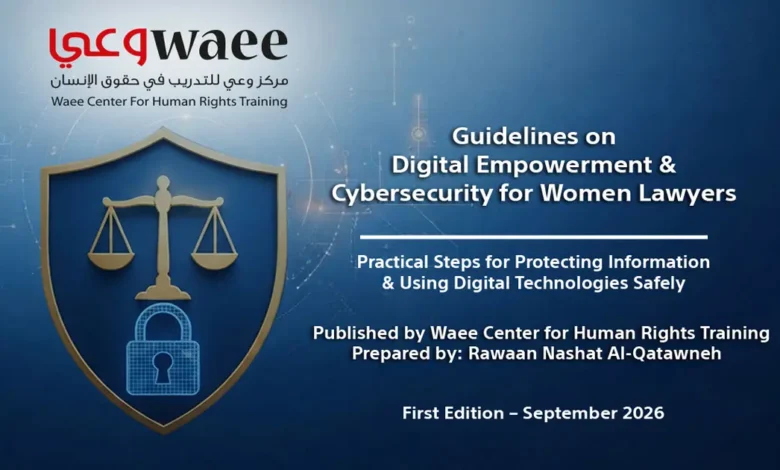
The Waee Center for Human Rights Training has published a specialized guide entitled “Digital Empowerment and Cybersecurity for Women Lawyers: Practical Steps for Protecting Information and Using Digital Technologies Safely.” The guide was prepared by Ms. Rawaan Al-Qatawneh, a specialist in cybersecurity and cybercrime, with the aim of strengthening women lawyers’ knowledge and skills in digital security and safety, and enabling them to protect their accounts, devices, case files, and clients’ data amid the growing risks in the digital environment.
The publication of the guide comes at a time of rapid transformation in the nature of legal practice, which is increasingly reliant on computers, smartphones, the Internet, and cloud-based services for communicating with clients, preparing documents and correspondence, managing case files, and using electronic services. Alongside this transformation, there has been a growing need to strengthen information security and safeguard the confidentiality and integrity of information, as these are essential components of a woman lawyer’s professional responsibility.
Lawyer Taghreed Al-Daghmi, founder of the Network of Women Lawyers to Combat Digital Violence against Women, stated that the publication of the guide responds to a practical need arising from the digital transformation of legal practice. The guide provides essential knowledge to help women lawyers understand the digital environment and the risks associated with it, take appropriate preventive measures, and respond effectively when a security incident occurs. She emphasized that cybersecurity is no longer a technical matter limited to specialists, but has become an integral part of women lawyers’ daily professional practice. She further noted that the guide does not require advanced technical knowledge and presents information in a practical, accessible, and simplified manner.
She added that addressing cases of digital violence requires, alongside legal knowledge, an understanding of the nature of digital attacks, the tools used by perpetrators, and methods for protecting accounts, information, and digital evidence. She noted that targeting a woman lawyer through digital means may have implications for her professional safety as well as the security of her clients’ information.
The guide complements the “Legal Defense and Advocacy Skills in Digital Violence Cases” guide previously published by the Waee Center, as part of an integrated framework for building the capacities of women lawyers to address digital violence. This framework brings together legal knowledge, specialized legal defense and advocacy skills in digital violence cases, as well as technical skills and knowledge of digital security and safety.
For her part, the guide’s author, Rawaan Al-Qatawneh, explained that the guide was developed in response to the transformation that has taken place in legal practice, whereby case files have moved from physical cabinets to digital devices, and with them, the responsibility of safeguarding client confidentiality has shifted from physical protection to digital protection.
Al-Qatawneh emphasized that the guide was designed as a practical, actionable tool rather than merely a set of general guidelines. Each section begins with a real-life scenario that a woman lawyer may encounter, followed by clear steps that can be implemented while reading. These steps cover understanding digital risks; securing accounts, devices, and passwords; enabling two-factor authentication; and addressing communication security, phishing, social engineering, and digital footprints. The guide also explains what to do in the event of a security breach, cyber extortion, or device loss, while emphasizing the importance of preserving and documenting digital evidence in a secure and systematic manner and avoiding actions that could result i
The guide also addresses the safe and responsible use of artificial intelligence in legal practice, outlining the risks associated with its use, such as the disclosure of confidential data or reliance on inaccurate information or incorrect references. It also introduces the fundamentals of digital evidence, emphasizing the importance of preserving its integrity and explaining how to properly collect and document it.
Al-Qatawneh emphasized that digital security is not limited to protecting devices and accounts, but extends to safeguarding the information entrusted to women lawyers by their clients. She noted that digital security and safety have become a natural extension of the duty of professional confidentiality. Accordingly, the guide was developed to equip women lawyers with the knowledge and practical tools needed to safeguard their clients’ confidentiality in their digital environments, just as they safeguard it in the courtroom.
Al-Qatawneh emphasized that the guide is an empowerment tool designed to help women lawyers move from being concerned users to informed users who are confident and in control of their digital tools. When a woman lawyer’s devices are compromised, the harm does not affect her alone; it may also affect everyone who has entrusted her with confidential information. For this reason, digital protection is no longer an additional skill, but a natural extension of the duty of confidentiality that lies at the heart of the legal profession.
The Waee Center emphasized that although the guide was primarily developed for women lawyers, it can also benefit male lawyers, particularly in securing accounts, devices, and legal files; preventing phishing and social engineering attacks; handling digital evidence and information securely; and using artificial intelligence responsibly.
The Waee Center hopes that the guide will serve as a practical reference for women lawyers and lawyers alike, contribute to fostering a culture of digital security and safety within the legal work environment, and strengthen the integration of legal knowledge with technical understanding. This, in turn, will help protect information and maintain client confidentiality, while contributing to building a safer and more just digital space.
The publication of the guide is part of the activities of the “Women Lawyers to Combat Digital Violence against Women through Technology” initiative, implemented by the Waee Center for Human Rights Training. The initiative aims to build women lawyers’ capacities in digital empowerment, cybersecurity, and legal defense skills in cases of digital violence, while strengthening their role in preventing and responding to digital violence against women and supporting survivors’ access to protection and justice.
The initiative responds to the recommendations of the fourth-cycle Universal Periodic Review (UPR) of Jordan, particularly those relating to combating violence against women, raising community awareness, building women lawyers’ capacities, and developing their skills to advocate for women and enable them to access justice.