Waee Center Commends Jordan’s Election to the UN Human Rights Council and Underscores the Importance of Its Membership in Strengthening Human Rights Protection and Upholding International Justice
Waee Center Highlights the Role of Jordan’s Human Rights Council Membership in Advancing National Priorities, Protecting Fundamental Rights, and Promoting International Accountability
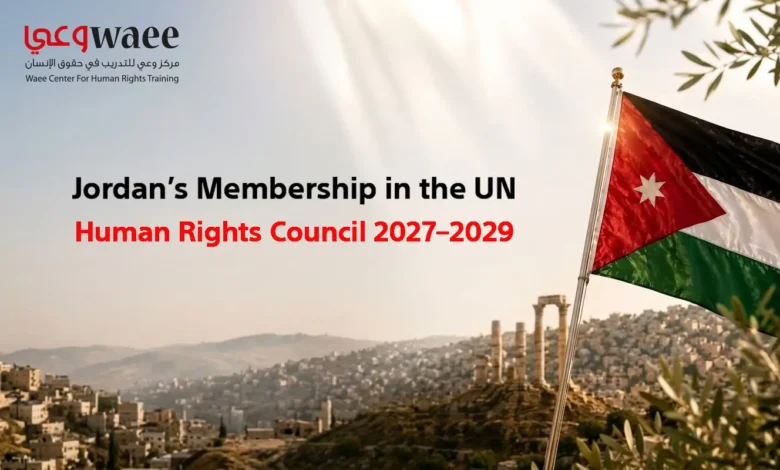
The Waee Center for Human Rights Training commends the Hashemite Kingdom of Jordan on its election to the United Nations Human Rights Council for the 2027–2029 term, having secured 171 votes. The Center considers this a significant milestone that strengthens Jordan’s presence in international forums dedicated to the protection of human rights and provides an opportunity to expand its contribution to international efforts aimed at upholding human dignity and promoting the principles of justice and equality.
The Center believes that the significance of this election extends beyond the diplomatic recognition it represents to encompass the responsibilities associated with Council membership, including supporting the international human rights system, strengthening respect for international law, defending fundamental rights and freedoms, and addressing violations without selectivity or double standards.
Linking International Membership to National Modernization Pathways
The Center emphasizes that this membership is particularly significant in light of Jordan’s national priorities and its political, economic, and administrative modernization pathways. Respect for human rights is a fundamental pillar of institution-building, strengthening the rule of law, expanding participation in public life, and fostering trust between citizens and state institutions.
This step also presents an opportunity to strengthen alignment between the Kingdom’s international obligations and its national efforts to develop legislation, policies, and practices related to human rights.
In this context, the Waee Center emphasizes the importance of continuing efforts to:
- Promoting freedom of opinion and expression.
- Upholding the principles of equality and non-discrimination.
- Supporting the role of national institutions and civil society organizations in promoting a human rights culture and monitoring challenges.
- Contributing to the development of public policies that respond to societal needs and protect rights and freedoms.
Human Rights Challenges in the Age of Digital Transformation
The Center also highlights the need to pay greater attention to emerging human rights challenges amid rapid digital transformation, particularly:
- Protecting privacy and personal data.
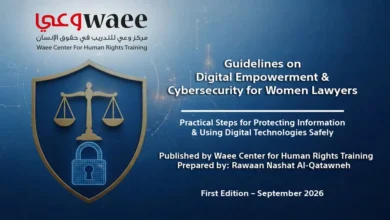
- Combating digital violence and strengthening cybersecurity.
- Ensuring the safe use of technology.
The Center emphasizes that the protection of human rights in the digital space has become an integral part of the human rights protection framework. This calls for continued efforts to develop legal frameworks, raise public awareness, and build the capacity of relevant stakeholders to prevent violations and respond to them, while ensuring respect for fundamental rights and freedoms.
Women’s Empowerment and Enhanced Participation
With regard to women’s empowerment, the Center considers Jordan’s membership in the Human Rights Council an opportunity to strengthen national and international efforts to ensure women’s safe and effective participation in public, economic, and social life, and to address all forms of violence and discrimination that may hinder the exercise of their rights.
The Center also underscores the importance of enhancing women’s access to justice, developing protection and redress mechanisms, and intensifying awareness-raising and training efforts that contribute to preventing violations and ensuring accountability for perpetrators.
Supporting Just Causes and Protecting Civilians in Armed Conflicts
At the international level, the Waee Center for Human Rights Training underscores the importance of leveraging Jordan’s membership in the Human Rights Council to strengthen international efforts to protect civilians in conflicts, uphold the principle of accountability for grave violations, and defend peoples’ rights to freedom, dignity, and self-determination.
The Palestinian cause stands at the forefront of these issues, carrying international and moral responsibilities that require respect for international law, the safeguarding of the legitimate rights of the Palestinian people, and efforts to address double standards in the application of human rights principles. These principles were reaffirmed by His Majesty King Abdullah II in his address to the United Nations General Assembly.
In this regard, the Center emphasizes the importance of making Jordan’s membership of the Council an opportunity to strengthen the prominence of these principles in international positions and contribute to building a more just and equitable human rights system—one in which rights are indivisible and justice is not subject to political considerations.
Tangible Impact and Sustainable Stability
The Waee Center for Human Rights Training emphasizes that the true value of this step lies in the ability to translate Jordan’s international presence into tangible impact at both the national and international levels. This can be achieved by supporting reform processes, strengthening partnerships between official institutions and civil society, and embedding a culture of human rights in legislation, policies, and practices.
In conclusion, the Center expresses its appreciation for this national achievement and looks forward to Jordan’s membership in the Human Rights Council serving as an opportunity to strengthen international cooperation, exchange expertise, and support initiatives aimed at protecting rights and freedoms in line with national priorities. This would further reinforce the role of human rights as a foundation for justice, stability, and sustainable development.