Waee Center Publishes the First Specialized Guide for Lawyers on Legal Defense Skills in Digital Violence Cases
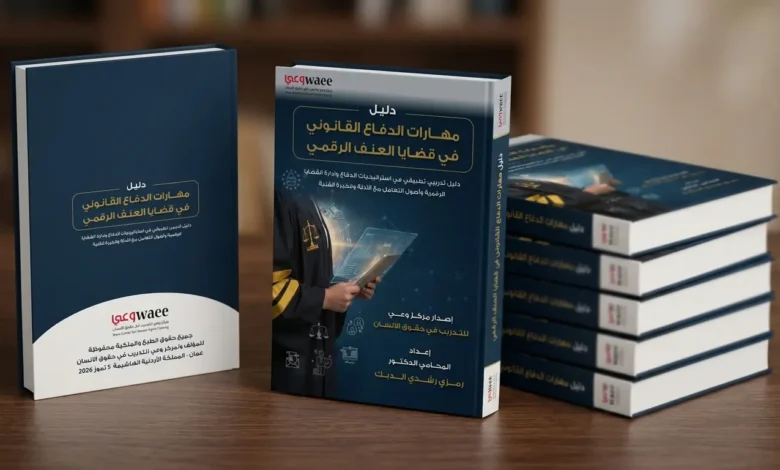
The Waee Center for Human Rights Training has published Jordan’s first specialized guide of its kind, titled “Legal Defense Skills in Digital Violence Cases,” prepared by legal expert and specialist Dr. Ramzi Al-Dabbak, Attorney-at-Law. This publication represents a significant step toward enhancing the capacity of lawyers to address cases arising from cybercrimes and digital violence, while keeping pace with rapid legal and technological developments.
Attorney Taghreed Al-Daghmi emphasized that the guide represents a practical and specialized reference for lawyers and is the first publication of its kind issued by the Center in this field. She explained that it was developed in response to the growing need to enhance legal defense skills in digital violence cases, strengthen understanding of the principles of handling digital evidence, develop technical expertise, and adopt modern defense strategies.
The guide also serves as a roadmap for lawyers, addressing the essential skills required for legal practitioners handling this type of case, as well as the mechanisms for developing a comprehensive legal defense strategy. It further covers the skills needed to examine and discuss technical reports related to digital evidence, in line with rapid technological advancements and the transition toward digital justice.
Today, lawyers are no longer required to have knowledge of legal texts alone; they must also possess an understanding of the nature of digital evidence and the mechanisms through which technological systems operate. This enables them to effectively utilize such knowledge in safeguarding their clients’ rights and building a strong and effective legal defense.
The guide’s author and compiler, legal expert Dr. Ramzi Al-Dabbak, Attorney-at-Law, explained that the publication adopts an applied methodology that bridges legal foundations with practical courtroom realities. It is based on relevant Jordanian legislation, foremost among them the Cybercrime Law, the Penal Code, the Criminal Procedures Law, and the Telecommunications Law, in addition to other regulatory and civil legislation. The guide also draws upon relevant judicial precedents and legal interpretations.
He further stated that the guide “was born out of a genuine professional need that we experienced in courtrooms before training halls. Today, lawyers stand before evidence that cannot be seen with the naked eye or touched by hand — electronic traces that are interpreted through devices and software rather than human senses — and they are required to analyze, examine, and challenge such evidence through the language of law. This guide provides them with both the methodology and the practical tools needed to do so.”
The guide is built upon an applied methodology that connects legal principles with judicial practice and practical technical expertise through six chapters. The first chapter establishes the legal concept of digital violence and its various forms — from electronic blackmail and character assassination to digital identity theft and cyberstalking — by identifying the precise criminal provisions applicable to each form under the Jordanian Cybercrime Law No. (17) of 2023 and the Penal Code. It also analyzes rules governing legislative overlap and the limitations on initiating criminal proceedings.
The second chapter addresses the nature of digital evidence, its characteristics, and the stages involved in handling it, from seizure and preservation to its presentation before the court. The third and fourth chapters are dedicated to the skills required to challenge the admissibility and evidentiary value of digital evidence — including the chain of custody, the Hash Value or digital fingerprint, and exceeding the scope of judicial authorization — as well as the skills needed to examine technical expert reports, request counter-expertise, and ultimately raise defenses related to deepfake technologies.
The fifth chapter outlines the development of a comprehensive defense strategy and the professional ethics governing legal practice in these sensitive cases. The sixth chapter focuses on the skills required to represent victims, ranging from urgent data preservation orders and content removal requests to remedies and reparation for harm suffered. The guide concludes with a set of findings and recommendations.
The guide concludes with practical appendices, including a trilingual glossary of technical, legal, and digital violence terminology, as well as reference checklists for procedural and technical defenses. It emphasizes that the publication “is not intended solely for defense attorneys and victims, but also extends to representatives of the Public Prosecution, the judiciary, law enforcement authorities, and other relevant stakeholders. Justice in these cases is not achieved merely through acquittal or conviction; it is also measured by protecting victims from further harm that may continue to affect them long after the incident itself.”
The guide further highlights that women and girls represent the group most vulnerable to these forms of crimes, according to United Nations data.
The guide serves as a valuable addition to continuous legal training programs, with the author expressing hope that it will “form the foundation for a robust Jordanian applied legal specialization in digital legal defense, one that balances fair trial guarantees with the protection of victims in a digital space that neither forgets nor forgives.”
The publication of the guide comes as part of the activities of the “Lawyers to Combat Digital Violence Against Women Through the Use of Technology” initiative, implemented by the Waee Center for Human Rights Training. The initiative seeks to strengthen the role of women lawyers in addressing digital violence and to build their legal and technical capacities to effectively handle this emerging category of cases.
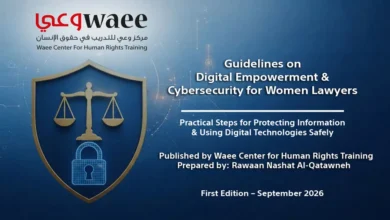
The initiative works to empower women lawyers in the areas of digital safety and security by equipping them with the knowledge and tools necessary to protect legal data and enhance their legal defense skills in digital violence cases, particularly those targeting women. It also supports their community role in raising legal awareness about mechanisms for preventing and addressing digital violence through lawful and secure approaches.
The initiative has implemented a series of specialized training programs in the governorates of Amman and Mafraq, covering digital empowerment, cybersecurity, and legal defense skills in digital violence cases. The initiative will continue, during the coming period, to deliver its training programs across various governorates of the Kingdom, contributing to the establishment of a national network of qualified women lawyers capable of handling digital violence cases with competence and professionalism.
The Lawyers Initiative aligns with the United Nations Human Rights Council resolution adopted on 7 July 2026 concerning digital skills development, cybersecurity skills, and professional development. The resolution affirmed that the full, equal, effective, and safe participation of women in digital spaces and the cybersecurity sector constitutes a fundamental pillar for the realization of human rights, the achievement of the Sustainable Development Goals, and inclusive digital transformation.
The initiative is also consistent with the resolution’s call to strengthen legislation, policies, and programs that ensure women and girls have equal opportunities in education, technical and vocational training, and employment within digital and technology sectors. Such efforts contribute to promoting women’s entrepreneurship, expanding women’s participation in the cybersecurity ecosystem, and supporting their balanced representation in this field, including through access to employment opportunities, professional development pathways, and leadership positions.