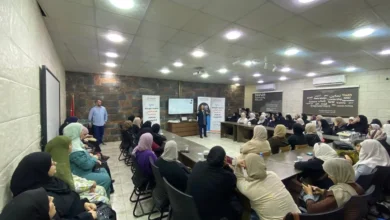
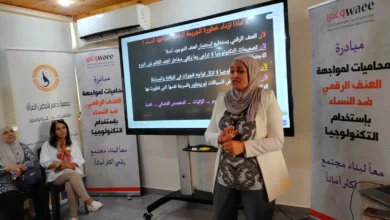
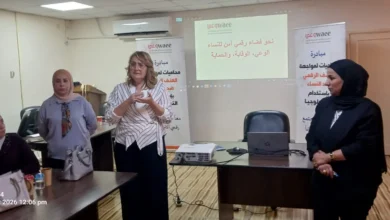
The Waee Center and the Network Against Digital Violence Against Women Journalists are conducting a training aimed at strengthening digital safety for journalists
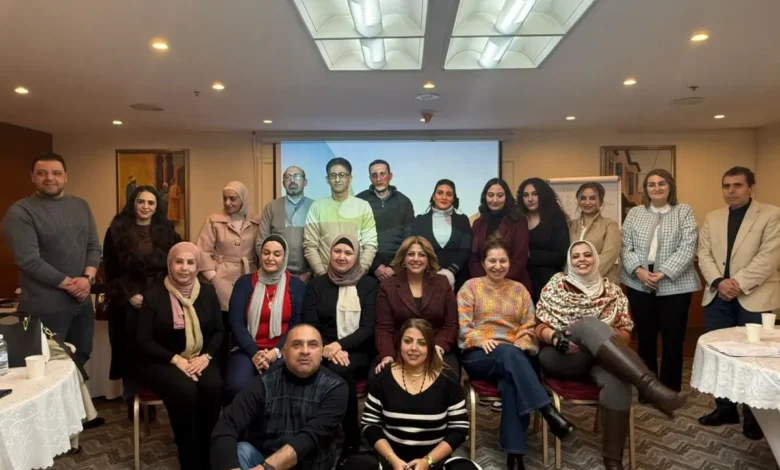
Amman – The Waee Center for Human Rights Training, in cooperation with the Network Against Digital Violence Against Women Journalists in Jordan and with the support of the Danish Institute for Human Rights, conducted a specialized two-day training course in the capital, Amman, on “Technology-Facilitated Violence and Mechanisms and Tools for Digital Safety for Journalists.”
The training targeted male and female journalists from various governorates working in local media outlets, digital platforms, and community media, in addition to the participation of representatives from relevant government entities. This was part of a participatory approach aimed at strengthening a shared understanding of technology-facilitated violence and developing more effective professional and institutional responses that safeguard rights and freedom of expression. The training comes amid a rise in patterns of digital violence targeting media professionals, particularly women journalists. These include defamation, threats, online blackmail, account hacking, and hate speech. Such practices not only cause individual harm but also have a direct impact on the safety of journalistic work, freedom of opinion and expression, and women’s presence in the digital public sphere.
The training aimed to strengthen the capacities of participants in the field of digital safety through a comprehensive approach that integrates the human rights, legal, and practical technical dimensions, while emphasizing the understanding of technology-facilitated violence as a form of gender-based violence, along with its associated complex legal and institutional challenges in the Jordanian context. The first day of the training focused on the conceptual, professional, and legal framework. The sessions addressed the concept of digital safety in journalistic work, technology-facilitated gender-based violence, its forms and causes, as well as the role of media institutions and official bodies in preventing digital violence and their legal and ethical responsibilities. An in-depth legal session was also dedicated to presenting and analyzing the Jordanian legislative framework governing publishing and digital journalism, including the Cybercrime Law and its amendments. The session further discussed challenges related to the interpretation of legal texts, the boundaries between legitimate criticism and criminalized acts, and their impact on journalists, both male and female.
The second day focused on the practical and applied aspects of digital safety, through specialized sessions covering password management and enabling two-factor authentication, securing personal and professional accounts, device and mobile phone security, and handling social engineering and phishing attempts. Participants were also trained on mechanisms for documenting and securely preserving digital evidence in a way that protects privacy while ensuring its admissibility and usability in potential legal or institutional proceedings.
In addition to the training content, the program provided an interactive dialogue space that brought together journalists and representatives of relevant government entities. The discussions addressed practical challenges related to technology-facilitated violence, mechanisms for implementing relevant laws, and the importance of coordination between media institutions and official bodies in a way that strengthens digital protection without undermining press freedom.
In this context, Taghreed Al-Daghmi, founder of the waee Center for Human Rights Training, stated that “addressing technology-facilitated violence requires a precise understanding of the legal context governing journalistic work and the digital space, particularly in light of rapidly evolving legislative amendments.” She added that “the lack of legal awareness among journalists may turn the law from a protective tool into a source of threat, which makes this type of training essential to empower them to understand their rights, the limits of their responsibilities, and how to take the correct legal action when facing digital violations.”
On her part, Rania Al-Saraireh, founder and coordinator of the Network Against Digital Violence Against Women Journalists in Jordan, affirmed that this training is part of the network’s ongoing efforts to build a safer digital media environment. She stressed that “strengthening digital safety is not limited to the technical aspect; it also involves building rights-based awareness, developing institutional policies, and enhancing cooperation between journalists, media institutions, and official entities to address digital violence as a public issue rather than an individual concern.”
The training concluded with an evaluation and an open dialogue session, which resulted in a set of key recommendations. These included the necessity of integrating digital safety into the internal policies of media institutions, expanding legal and psychological support programs for journalists, and developing clear institutional response mechanisms to address cases of technology-facilitated violence, in addition to strengthening cooperation between civil society and relevant governmental entities.
It is worth noting that the waee Center for Human Rights Training works in partnership with national and international institutions to develop the capacities of media professionals and public actors.
Meanwhile, the Network Against Digital Violence Against Women Journalists in Jordan has continued its work since its establishment in 2022, providing training, legal and psychological support, and advocacy for policies and legislation that protect media workers from all forms of digital violence.
Recently, the waee Center for Human Rights Training launched the “Women Lawyers Against Digital Violence Against Women” network, which aims to counter technology-facilitated violence against women by strengthening women lawyers’ capacities in digital safety and security, and providing them with the necessary support to enable them to defend women’s rights.
Al-Daghmi stated that the network will begin by strengthening and empowering its members in digital security and addressing technology-facilitated violence, as well as promoting awareness, so that they may later become qualified to train women in their respective regions and defend them. This contributes to creating a safer working environment for women lawyers and women in general on the internet and social media platforms. She noted
that membership in the network is open to all women lawyers across the various governorates of the Kingdom. Al-Daghmi also emphasized the importance of the role of women lawyers in combating technology-facilitated violence against women, through providing legal support to survivors, representing them before relevant authorities and courts, and raising legal awareness about this form of violence, how to address it, and how to protect against digital threats such as account hacking, creation of fake accounts, manipulated offensive images, cyberbullying, verbal abuse, and other forms of digital violence.